


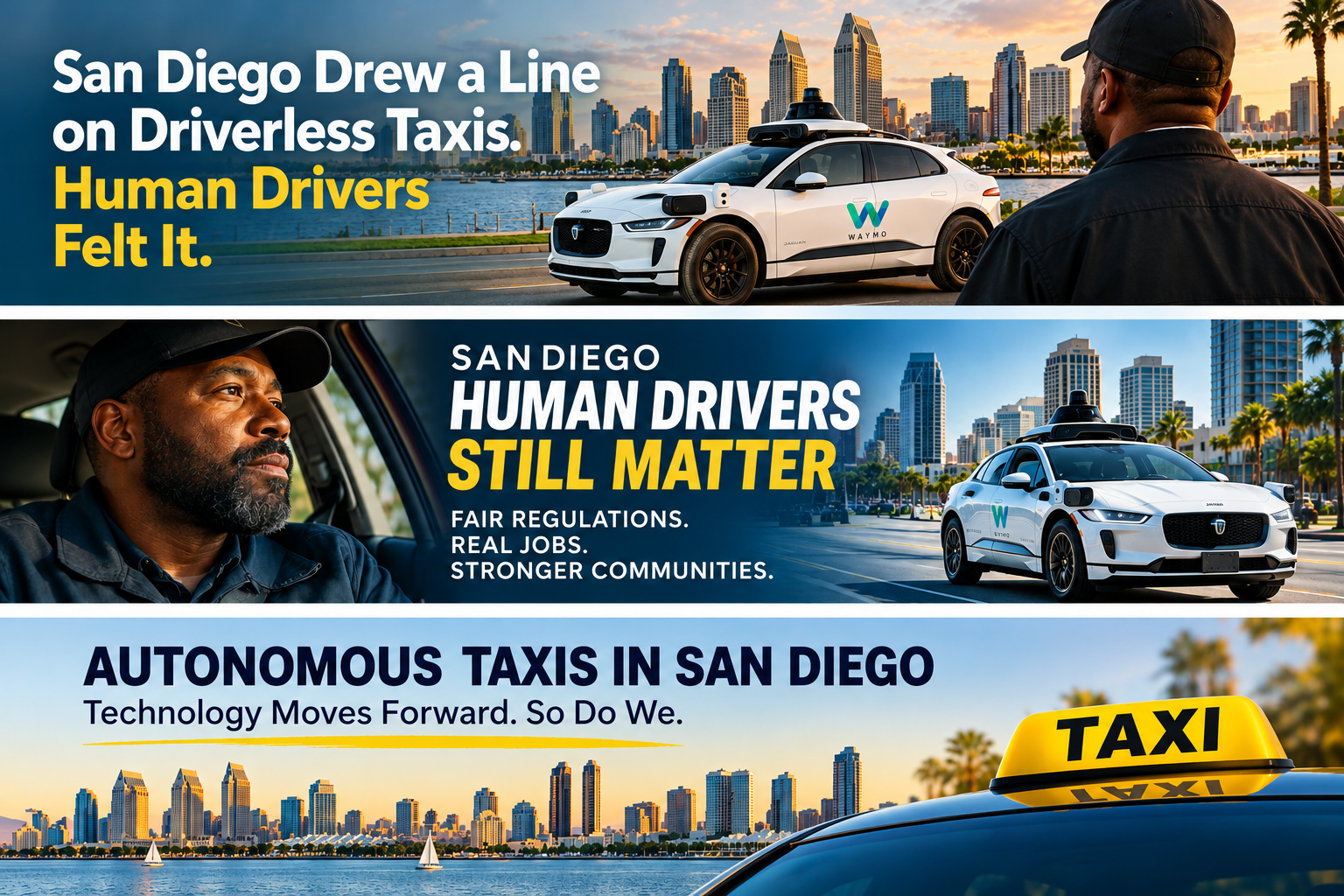
San Diego Drew a Line on Driverless Taxis. Human Drivers Felt It.
San Diego did not become a city you can actually get around because a corporation dropped a fleet of empty cars on the curb. It became that city because human beings—taxi drivers, independent operators, people who learned the airport, the hospitals, the late-night neighborhoods, and the regulars who need a person in the front seat—showed up for years and did the work.
I’m Mikaiil Hussein, president of United Taxi Workers of San Diego. I write this as a long piece for drivers, for passengers, and for anyone who still thinks “autonomous” is a magic word that erases labor. Driverless taxis are on the rise. Waymo is now licensed to pick up customers on San Diego’s streets. Tesla is pushing CyberCab and is beta-testing our roads. None of that is a rumor. What is also true, and what too many tech stories skip, is this: local taxi drivers just marked a real success. San Diego City Council with the passing of Item 201 put effort into controlling autonomous taxi regulations instead of treating robotaxis as inevitable weather.
That is not a thank-you note. It is a report from the street about what regulation means when you actually drive for a living.
The market they want, and the city we already have
Rideshare companies spent a decade telling the public that the future of getting from A to B was an app and a contractor in a personal car. Now the same logic is being pushed one step further: keep the app, keep the streets, keep the fares, and remove the human being. Waymo’s model is a branded robotaxi that can legally pick up riders here. Tesla’s CyberCab pitch is the same destination with different marketing—autonomous service competing for the same trips taxi and rideshare drivers live on.
For passengers, the sales language is convenience, safety, and modernity. For drivers, the math is simpler. Every trip an empty vehicle takes is a trip that does not pay rent, insurance, a medallion or permit, a car note, or a family. There is no tip. There is no one to organize. There is no one who knows that a particular corner floods, that a particular hotel needs a human to help with bags, that a senior needs patience, not a door that closes on a schedule written in Mountain View or Austin.
UTWSD has said this from the beginning. We stand with human drivers who have been putting in the work for years to help San Diegans. We are not confused about technology. We are clear about power. A licensed robotaxi is not a science-fair project. It is a commercial competitor with enormous capital, data, and lobbyists, rolling onto the same asphalt as people who already paid their dues in traffic.
What “licensed to pick up customers” actually means
When people hear that Waymo is licensed to pick up customers on San Diego streets, some hear a headline. Drivers hear a change in the shift. It means autonomous vehicles are not only testing in a closed loop. It means they can take the work: the airport surge, the downtown hop, the late-night ride, the trip that used to be the difference between a decent night and a wasted tank of gas.
Waymo and Elon’s CyberCab point at the same prize. Call it robotaxi, driverless vehicles, or Cyber transport—the product is a vehicle without a worker. The companies will talk about software. We talk about who gets to eat.
That is why regulation is not a side issue. If the City of San Diego treats autonomous taxis like a gadget, the gadget wins. If they treat them like a taxi and rideshare business that uses public streets, public curbs, and public trust, then human drivers still have a chance to be seen as what we are: the existing transportation workforce, not a glitch in someone else’s launch plan.
The success: City Council treated autonomous taxis as something San Diego can govern
Here is the success for local taxi drivers, stated without romance. San Diego City Council put work into controlling how autonomous taxis will be regulated meaning making the playing field even for human just as for robot. That sounds dry until you have sat through years of being told that technology moves faster than democracy. “Like it or not” is a phrase built to shut workers up. San Diego governing body’s effort said the opposite: San Diego still has a say about safety, about who is liable, about accessibility, about congestion, and about whether a robot fleet gets a blank check on streets we already work.
I thank San Diego City Council especially Councilman Sean Elo for spearheading the effort—not as a polite closing line, but as a fact. Elected officials can still decide that autonomous service is a regulated industry, not a coronation. They can still hear that a camera stack is not a substitute for a driver who can help a passenger in a wheelchair, de-escalate a bad situation, or refuse to leave someone stranded because the software got confused.
For UTWSD, that is a win because it moves the fight out of marketing and into rules. Rules can be argued. Rules can include human workers. Press releases cannot.
What regulation has to cover if it is going to mean anything
Controlling autonomous taxi regulations is not one vote and a nap. If San Diego is serious, the public process has to stay on the issues drivers already live with and it should be ongoing.
Labor and earnings.
A fleet with no driver is a direct hit on people who already operate on thin margins. Any honest regulation looks at trip volume, airport access, curb space, and whether driverless vehicles are allowed to flood the same zones where human drivers wait. If the city only counts “innovation” and never counts lost shifts, it is not governing anything. It is cheering.
Safety and liability.
When something goes wrong with a human driver, there is a person, a license, insurance, and a chain of responsibility you can actually find. When something goes wrong with a driverless taxi, the public gets a maze of manufacturer, operator, software vendor, and “the vehicle was in autonomous mode.” San Diego should not accept a product on its streets unless a rider, a pedestrian, and a working driver can see who pays and who answers.
Accessibility.
Taxi drivers help people who do not fit a demo video. Wheelchairs, walkers, service animals, language, panic, intoxication, kids, luggage. If an autonomous taxi cannot serve the full public, it is not a replacement for taxi service. It is a boutique product using public right of way. Regulation has to say that out loud.
Data and the curb.
These companies run on maps, cameras, and political access. Drivers run on knowing the city. Who gets priority at the airport? Who sits on the curb downtown? Who is allowed to deadhead empty cars through neighborhoods to wait for a ping? Those are labor questions dressed up as traffic questions.
Transparency.
Drivers should not learn about expansions from a billboard. If Waymo scales, if CyberCab tries to enter, the public and the workforce deserves advance notice, hearings, and impact information—not a shrug or a simple headline from a news station.
What I need drivers to understand, in plain English
This moment is a small win. It is not a retirement party. Waymo will still be picking up riders. Tesla can still sell the idea that CyberCab is the future. Other companies will follow if the money is there. Capitalism wants the fare without the wage. That will not change because the city did the right kind of work once.
So this is what I tell taxi and rideshare drivers across San Diego:
First, this is about labor. If there is no driver, there is no paycheck. Do not let anyone rebrand that as “efficiency” without asking efficiency for whom.
Second, a license to pick up customers is not a license to ignore the people who already do that job. The city of San Diego and the state of California still owe the public a real look at safety, access, insurance, and earnings.
Third, do not wait for the driverless ride industry to educate you. They will educate you about convenience. They will not educate you about your future.
Fourth, we inform our own. Rumors help the companies. Facts and a Ride United membership help us. UTWSD exists so drivers are not alone with a phone and a bad night.
Human drivers are not a “legacy problem”
Tech coverage loves a timeline where the past is a taxi and the future is a robot. That timeline is an insult. The past is still the present: people who know San Diego because they work it. We deal with drunk passengers, lost tourists, workers trying to make a shift, families at the airport, patients leaving clinics. We paid for cars, insurance, permits, and time. We are not a bug in the software. We are the service.
When I say United Taxi Workers of San Diego stands with human drivers, I mean the whole picture. I mean the driver who has been here twenty years and the driver who just started. I mean taxi and the people in rideshare who are being told the same story: you were useful until the company could try to delete you.
A city that respects itself does not throw that workforce away because a well-funded fleet got a license. A city that respects itself regulates the newcomer the way it should have always regulated anyone making money on public streets.
What “success” has to look like next
Council’s effort on autonomous taxi rules is a foundation, not a finished house. Success going forward looks like drivers at the table before the next expansion, not after the cars are already circling. It looks like hearings that treat earnings and displacement as seriously as they treat a company’s press kit. It looks like accessibility that is mandatory, not optional. It looks like liability that a regular person can understand. It looks like airport and curb rules that do not quietly starve human drivers while robotaxis idle in the best spots.
I am not asking San Diego to freeze time. I’m asking San Diego to keep up the fight. Innovation is not a veto over workers. If Waymo or any other autonomous brand wants this market, they can meet a city that already decided human drivers count.
The work in front of UTWSD
UTWSD will keep informing drivers about Waymo, CyberCab, and every other attempt to run taxis driverlessly in San Diego. We will keep showing up where rules are written. We will keep saying that San Diegans are served by people, not only by sensors. And we will keep treating San Diego’s work on this file as proof that local power still matters—if workers use it.
Isolated drivers lose. United drivers can still demand a public process, fair permitting, and a future in which putting in the years on these streets is not a footnote to someone else’s launch.
San Diego drew a line. Human drivers felt it. The job now is to hold that line, widen it, and make sure the next headline is not “like it or not,” but “not without us.”
United Taxi Workers of San Diego stands with you, human drivers.
We put in the years. We know these streets. We are still here.
Mikaiil Hussein is president of United Taxi Workers of San Diego.